INTRODUCTION: A HISTORIC SHOCK AND THE CONTINUING JOURNEY OF RITONAVIR
In the history of the pharmaceutical industry, few stories are as dramatic or offer as many valuable lessons in pharmaceutical physical chemistry as that of ritonavir (brand name Norvir), an antiviral drug used in the treatment of HIV infection.
If you have ever studied the phenomenon of polymorphism, you may remember the infamous 1998 incident. At a time when ritonavir was being successfully marketed in its Form I crystalline form, a new crystalline form, Form II, unexpectedly emerged in the manufacturing process. Form II was thermodynamically more stable but significantly less soluble than Form I. As a result, the drug precipitated within the capsules, causing a substantial decline in bioavailability. The manufacturer was forced to urgently withdraw the product and invest hundreds of millions of dollars in reformulating it.
The displacement of Form I by Form II became a landmark case in pharmaceutical science and a classic example that every pharmacy student encounters when studying pharmaceutics and pharmaceutical quality control.
Many assumed that once the Form II problem had been resolved, the investigation into ritonavir's crystalline forms had come to an end.
However, science never stands still. More than two decades after this groundbreaking incident, ritonavir crystals continue to challenge researchers and reveal unexpected discoveries. The story of this molecule is far more complex and fascinating than we once imagined.
7. THE STORY IS NOT OVER: RITONAVIR ALSO HAS FORM IIIB
One might assume that, following the Form II incident, scientists had already uncovered everything about ritonavir.
But that was not the case.
In 2022, a new polymorphic form of ritonavir, Form IIIb, was discovered through melt crystallization and subsequently reported in 2023.
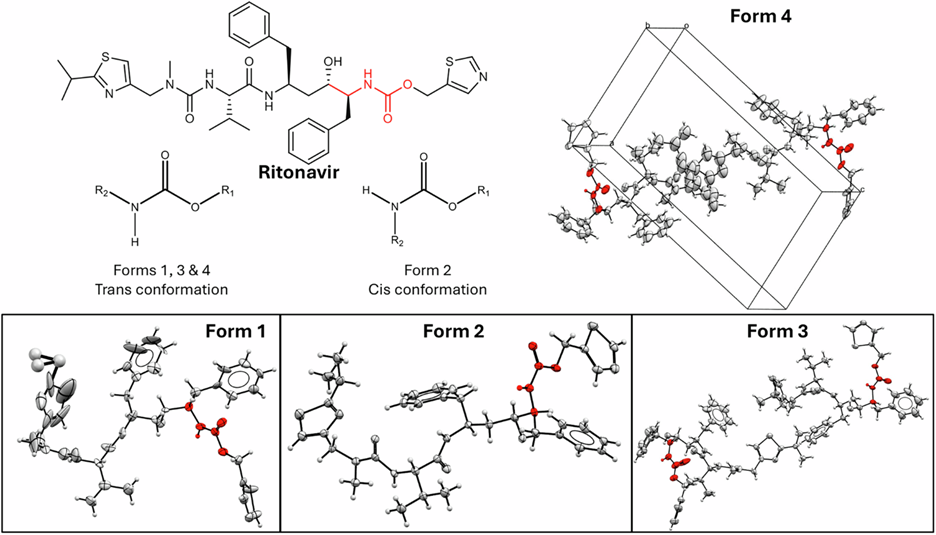
What makes this discovery particularly interesting is that Form IIIb exhibits a different crystal structure, molecular conformation, and hydrogen-bonding network compared with Form I and Form II.
Form IIIb was identified as the least thermodynamically stable of the three forms under a monotropic relationship.
This finding highlights an important scientific lesson:
Failing to identify a polymorph does not necessarily mean that the polymorph does not exist.
A crystalline form may be extremely difficult to produce under conventional conditions but can emerge when the crystallization method or experimental conditions are changed.
8. AND THE STORY CONTINUES: RITONAVIR FORM IV
If the discovery of Form IIIb seemed to complete the polymorphic map of ritonavir, subsequent research suggested otherwise.
In 2026, the crystal structure of ritonavir Form IV was determined and reported in the journal Crystal Growth & Design.
This was a noteworthy discovery because Form IV had already been recognized, but its crystal structure had not previously been fully determined.
Using electron diffraction, researchers successfully determined the crystal structure of this polymorph.
Interestingly, Form IV shares similarities in molecular conformation and hydrogen-bonding patterns with Form I and Form III, suggesting that ritonavir polymorphs are not necessarily entirely different in the way their molecules organize themselves. Instead, they may share certain structural characteristics.
However, an even more significant finding concerns the thermodynamic relationships among the different crystalline forms.
The 2026 study indicated that Form II remains the most thermodynamically stable form among the four known ritonavir polymorphs.
In other words, although scientists continue to discover new crystalline forms, Form II remains the thermodynamic endpoint among the four known polymorphs.
9. FROM A MANUFACTURING CRISIS TO A LANDMARK LESSON IN PHARMACEUTICAL SCIENCE
Today, ritonavir is regarded as one of the most prominent examples of how polymorphism can influence drug quality and performance.
Modern research has also revealed that its solid-state chemistry is considerably more complex than the original Form I/Form II distinction.
Scientists have investigated various solid forms of ritonavir, including different polymorphs, hydrates, and solvates.
More recent studies have even revisited the crystal structures of Form I and Form II using advanced techniques such as NMR crystallography, demonstrating that ritonavir remains a fascinating research system more than two decades after the original incident.
10. WHAT SHOULD PHARMACY STUDENTS LEARN FROM THE RITONAVIR CASE?
The entire ritonavir story can be summarized in the following sequence:
The same active pharmaceutical ingredient
↓
Different molecular arrangements within the crystal lattice
↓
Different polymorphic forms
↓
Different crystal lattice energies
↓
Different solubility and dissolution rates
↓
Different drug release and absorption characteristics
↓
Potential differences in bioavailability and product quality
Therefore, when studying solubility, dissolution rate, solid dosage forms, raw material quality control, or formulation development, remember that the statement “ritonavir is still ritonavir” does not tell the whole story.
In pharmaceutical physical chemistry:
The same molecule does not necessarily form the same crystal structure, and different crystal structures do not necessarily exhibit the same pharmaceutical behavior.
That is precisely why the ritonavir case continues to be discussed and studied many years after the 1998 incident.
REFERENCES
[1] Bauer, J., Spanton, S., Henry, R., Quick, J., Dziki, W., Porter, W., & Morris, J. (2001). Ritonavir: An extraordinary example of conformational polymorphism. Pharmaceutical Research, 18(6), 859–866.
[2] Chemburkar, S. R., Radich, G., Patel, B., Spiwek, H., Studelska, D. R., Robbins, G., ... & Bauer, J. (2000). Dealing with the impact of ritonavir polymorphs on the late-stage development and commercialization of Norvir® oral solution. Organic Process Research & Development, 4(5), 413–417.
[3] Dunitz, J. D., & Bernstein, J. (1995). Disappearing polymorphs. Accounts of Chemical Research, 28(4), 193–200.
[4] Morissette, S. L., Soukasene, S., Levinson, D., Cima, M. J., & Almarsson, Ö. (2003). High-throughput crystallization: Polymorphs, salts, co-crystals and solvates of pharmaceutical solids. Advanced Drug Delivery Reviews, 55(3), 261–300.
[5] Yao, Y., Ma, C. Y., Wang, C., Turner, T., & Roberts, K. J. (2023). Melt crystallization and structural characterization of a new ritonavir polymorph: Form IIIb. Crystal Growth & Design, 23(8), 5890–5901.
[6] Parent, S. B., et al. (2026). Crystal structure determination of Ritonavir Form IV via electron diffraction and its thermodynamic relationships. Crystal Growth & Design, 26(2), 1120–1132.
Authors:
MSc. Nguyễn Xuân Tú
MSc. Nguyễn Yên Hà
Publication date: October 31, 2026

